
Loading articles.
Loading the article.
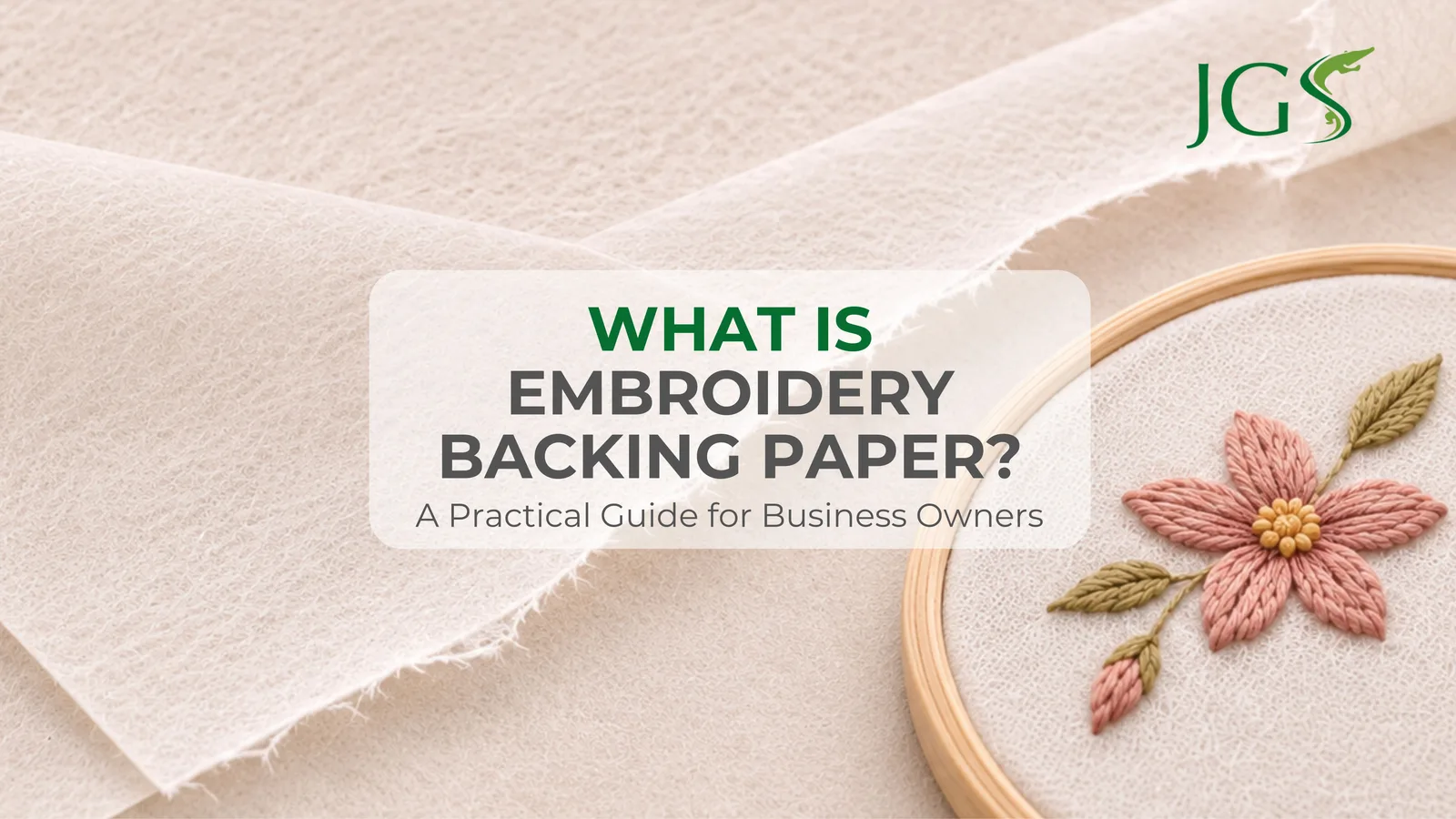
Embroidery backing paper is the hidden layer that decides whether an order ships or gets stitched twice. Here’s what it is, the four main types, and how to choose the right one for your fabric.
By JGS Tex Fab
Embroidery backing paper, more accurately called an embroidery stabilizer, is a support layer placed under fabric during machine embroidery. Despite the name, it is usually a non-woven fabric, not paper. It stops fabric from stretching, shifting or puckering under thousands of needle punches, so stitches stay crisp and designs line up.
For a business, that is no technical footnote: it decides whether an order ships or gets stitched twice. JGS Tex Fab has made technical non-wovens in Kolkata since 1991, and embroidery backing paper is part of our range.
Picture a dense logo on a stretchy polo with no proper support. The fabric pulls during stitching, then relaxes, so the outline no longer meets the fill. Now you are writing off a (an illustrative figure) ₹500 blank polo to save a few rupees on backing. Across a 50-piece uniform order, the right backing is the cheapest insurance in your shop.
Suppliers use these words loosely. Backing and stabilizer mean the same thing: material under the fabric. Topping is a water-soluble film on top that keeps stitches from sinking into towels. Interfacing is a fusible fabric some shops borrow as backing.
Some examples: a polo gets cut-away. A towel gets tear-away underneath plus water-soluble topping. A denim jacket with a small logo can take tear-away, but switch to cut-away for a large design.
Weight is listed in GSM. Lighter grades suit fine fabrics and small designs, heavier ones suit dense stitching, but over-stabilizing makes garments stiff.
For a quick test, maybe. For paid orders, no: paper leaves lint, supports inconsistently and gives no wash durability. Saving a few rupees can cost you the order.
Stitch your real design on a scrap of the actual fabric and wash it a few times. Record the winning combination for each garment type and make it your shop standard. When you buy in bulk, specify GSM and roll width; at JGS Tex Fab, rolls are slit to your width and inspected before dispatch.
Not sure which grade suits your fabric and stitch count? Send the JGS Tex Fab team your fabric, GSM and run size, and we’ll recommend a backing and send a sample. Request a sample
Keep reading
 2 min read
Understand how OEKO-TEX certification helps garment brands meet buyer expectations, improve material safety assurance, and choose reliable interlining and non-woven fabric for quality-conscious apparel production.
Read the article 3 min read
Learn what GSM means in fabric, why it matters, and how to choose the right fabric weight for garments, fusible interlining, and non-woven applications.
Read the article 3 min read
Discover how chemical bond non-woven fabric is used across apparel, leather goods, automotive, filtration, packaging, hospitality, and electrical industries, and learn how to choose the right specifications for your application.
Read the articleLet's Connect
Tell us the fabric, the garment and the run size. We will come back with the interlining that fits, and a sample to prove it.
Send an enquiry