Loading articles.
Loading the article.
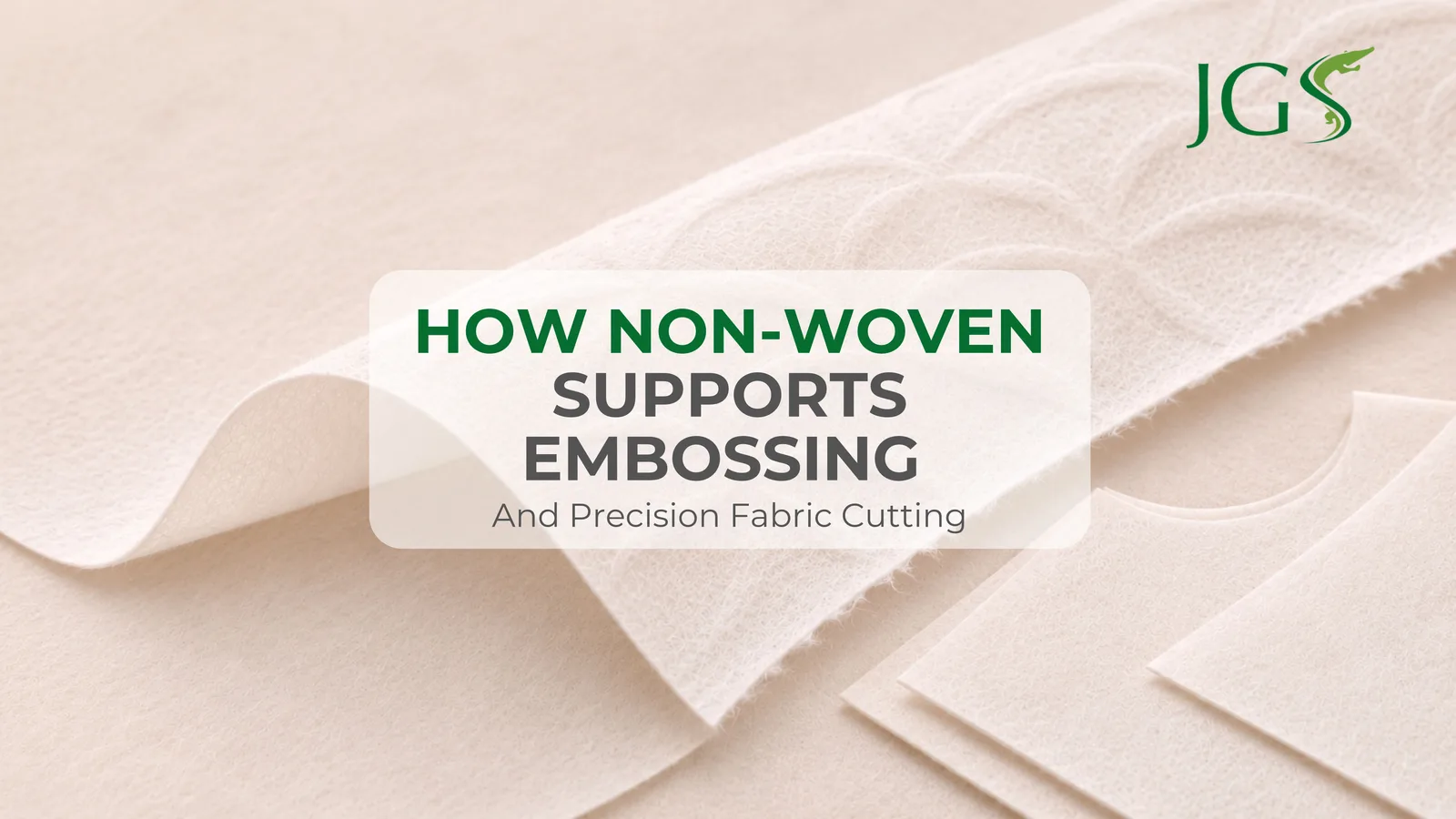
Discover the role of non-woven fabric in embossing and precision cutting, from improved material stability to better production consistency.
Non-woven fabric for embossing plays an important role in textile applications where dimensional stability, surface finish, and material consistency matter. During embossing and precision fabric cutting, fabrics are exposed to heat, pressure, and mechanical force. Without proper support, materials may shift, stretch, or lose their shape, affecting the final result.
Non-woven materials provide an additional supporting layer that helps improve stability during these processes. Understanding their properties and applications can help manufacturers select the right material for their production requirements.
Unlike woven or knitted fabrics, non-woven fabric is made by bonding fibres together rather than interlacing yarns. This construction offers several useful characteristics:
These properties make non-woven backing a useful option in selected embossing and precision fabric cutting applications.
Embossing on fabric involves applying heat and pressure to create patterns or textures on a material's surface. However, thin or flexible fabrics may shift or distort during the process.
Using a suitable non-woven backing can provide additional body and support, helping maintain the fabric's structure during embossing. It can be considered for applications involving home furnishing, automotive interiors, and leather accessories.
The performance of the backing depends on its fibre composition, bonding method, GSM, and compatibility with the embossing temperature. Testing before bulk production is important.
Precision fabric cutting requires materials to remain stable while being processed. Movement during cutting can result in inconsistent dimensions, uneven edges, and material waste.
A suitable non-woven fabric for cutting can provide additional support during die cutting, CNC fabric cutting, and laser cutting applications.
For example, when producing multiple fabric components of the same size, a stable backing layer can help reduce movement and improve cutting consistency. Manufacturers should test the material with their specific cutting equipment and settings.
Selecting the right material depends on the application and production requirements.
With over 35 years of experience in technical textiles, JGS Tex Fab manufactures chemical bond and thermo bond non-woven fabrics ranging from 25–90 GSM. With in-house manufacturing, testing, and finishing capabilities, the company offers material options for varied industrial and textile applications.
Whether the requirement involves embossing or precision fabric cutting, selecting the right non-woven material is an important step towards consistent production quality.
Keep reading
 3 min read
Learn what GSM means in fabric, why it matters, and how to choose the right fabric weight for garments, fusible interlining, and non-woven applications.
Read the article 3 min read
Discover how non-woven fabric supports edible oil and coolant filtration, and learn how to choose the right filter material based on strength, GSM, fluid compatibility, and filtration performance.
Read the article 3 min read
Discover how chemical bond non-woven fabric is used across apparel, leather goods, automotive, filtration, packaging, hospitality, and electrical industries, and learn how to choose the right specifications for your application.
Read the articleLet's Connect
Tell us the fabric, the garment and the run size. We will come back with the interlining that fits, and a sample to prove it.
Send an enquiry